
October 2026 gives Chennai skywatchers several genuinely worthwhile reasons to look up. Saturn reaches opposition and becomes the month’s standout planet, Mars moves through the Beehive Cluster before sunrise, the New Moon creates the best dark-sky window, the Orionid meteor shower peaks late in the month, and the Full Moon closes October with a bright evening rise.
From Chennai city, the Moon and planets are the safest targets because they remain visible despite light pollution. Darker locations make meteor showers and star clusters more rewarding.
Here is what to see, when to look and what equipment helps.
October 2026 Night Sky in Chennai: At a Glance
| Date | What to See | Best Chennai Time | Where to Look | Best Equipment |
|---|---|---|---|---|
| Oct 4 | Saturn at opposition | 7:00 pm onward; best 8:00 pm–midnight | East to south | Naked eye + telescope |
| Oct 5 | Moon near Mars | 3:00–5:15 am | East | Naked eye / binoculars |
| Oct 6 | Moon near Jupiter | 3:30–5:15 am | East | Naked eye / telescope |
| Oct 8–9 | Draconid meteor shower | Around 7:00–10:00 pm | Broad northern sky | Naked eye |
| Oct 10 | New Moon | After evening twilight | Whole sky | Any |
| Oct 11 | Mars in the Beehive Cluster | 3:00–5:15 am | East | Binoculars |
| Oct 18 | First Quarter Moon | 6:30–10:30 pm | South to southwest | Telescope |
| Oct 21–22 | Orionid meteor shower | Oct 22, 2:30–5:15 am | Broad sky | Naked eye |
| Oct 24 | Moon near Saturn | 9:00 pm–midnight | Southern sky | Naked eye / telescope |
| Oct 26 | Full Moon | From about 5:45 pm | East-northeast | Naked eye / telescope |
| Oct 27–28 | Moon near the Pleiades | Evening | East | Binoculars |
October 4: Saturn at Opposition — The Best Planet Event of the Month
If you plan only one planetary observation in October, make it Saturn.
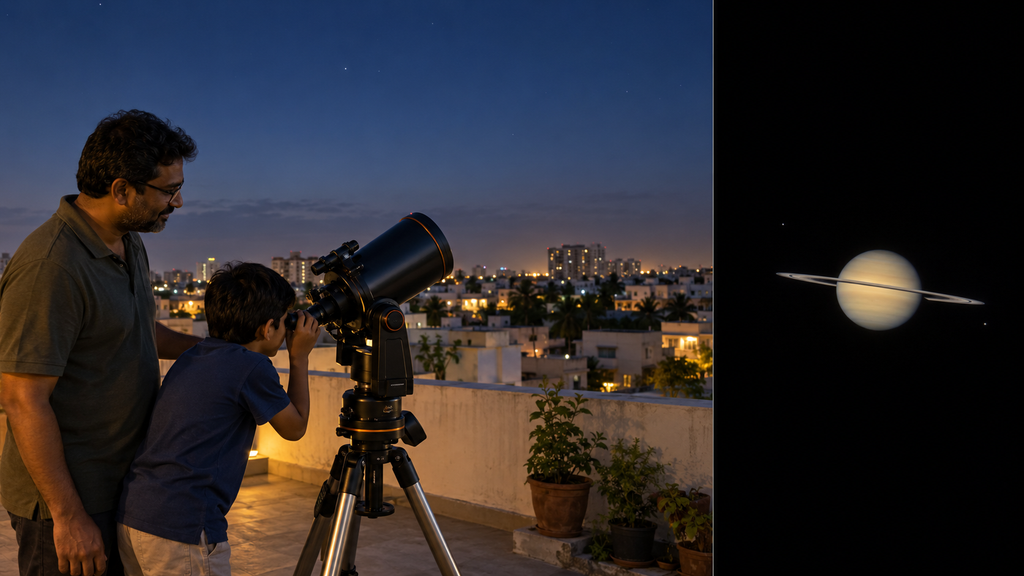
Saturn reaches opposition on October 4. Opposition happens when Earth lies roughly between the Sun and Saturn, so Saturn appears opposite the Sun in our sky. The practical result is excellent for observers: Saturn rises around sunset, stays visible for most of the night and is especially well placed for telescope viewing. NASA also highlights October 4 as a prime 2026 Saturn-viewing opportunity.
From Chennai, start looking east after darkness settles. Around 8:00 pm to midnight is a comfortable window for families and beginners as Saturn climbs higher and atmospheric distortion usually improves.
Can you see Saturn without a telescope? Yes. It looks like a bright, steady, star-like point. But you need magnification to see its rings. Through a suitable telescope, Saturn becomes a tiny ringed world, and Titan, its brightest moon, may also be visible.
Curious about Saturn’s huge moon family? Read our guide to how many moons the planets have.

Want to turn Saturn from a point of light into a real telescope moment?
Stargazing Chennai can plan a guided session around your date, location, weather and usable sky.
*Visibility is condition-dependent, but Saturn is a memorable first telescope view.
October 5–6: Moon, Mars and Jupiter Before Sunrise
Early risers get two easy planet pairings.
On October 5, the waning Moon appears near Mars in the eastern predawn sky. Try roughly 3:00 am to 5:15 am. Mars should look like a reddish-orange point near the Moon.
On October 6, the Moon appears near bright Jupiter before sunrise. Jupiter should stand out clearly once it clears buildings or trees. A small telescope may also show several Galilean moons. NASA includes the Moon–Jupiter pairing among October’s notable skywatching moments.
Some global astronomy calendars mention a Jupiter occultation on October 6. Chennai does not get the disappearance of Jupiter behind the Moon; the useful local event is the close Moon–Jupiter pairing.
October 8–9: Can You See the Draconid Meteor Shower from Chennai?
Yes, but keep expectations realistic. The Draconids are usually a modest shower rather than a meteor storm.
The Moon is favourable because New Moon is only two days away. Chennai’s bigger limitation is city light pollution. Try roughly 7:00 pm to 10:00 pm on October 8 from the darkest safe location available.
Do not use binoculars or a telescope. Meteor showers are best watched with the naked eye because you need a wide field of view.
For a better meteor experience, travelling outside the city helps far more than increasing telescope power. Explore our guide to the best stargazing spots near Chennai and compare October with the stronger displays in our 2026 Chennai meteor-shower guide.
October 10–12: The Best Dark-Sky Window of the Month
New Moon occurs in Chennai on October 10 at about 9:20 pm IST, making October 9–12 the month’s best period for moonless observing.
A New Moon removes lunar glare; it does not remove Chennai’s artificial skyglow. Inside the city, bright planets and easy star clusters still give the best results. Outside Chennai, however, more stars become visible and binocular targets gain much better contrast.
If you are planning a New Moon trip, our Bortle Scale guide to dark-sky locations in Tamil Nadu and India explains why the same night can look dramatically different simply by changing location.
October 11: Mars in the Beehive Cluster — October’s Best Binocular Event
Before sunrise on October 11, Mars appears among the stars of the Beehive Cluster, also called Messier 44, M44 or Praesepe, in the constellation Cancer. Independent observing charts place Mars within the famous cluster before sunrise on this date.
From Chennai, look east between roughly 3:00 am and 5:15 am.
Mars itself should be easy to identify by its orange-red colour. The Beehive is much more affected by city brightness, which is why binoculars are ideal: they reveal the cluster while keeping enough sky in view to appreciate Mars among the stars.
The timing is especially good because the event falls immediately after New Moon, so lunar glare is almost absent.
What About Mercury and Venus in October?
Both are evening objects early in the month, but they sit low toward the western horizon after sunset. Buildings, trees, haze and twilight can easily hide them from a normal Chennai terrace. Early-October Chennai visibility data shows both setting relatively soon after sunset.
Treat Mercury and Venus as bonus sightings if you have a clear western horizon rather than building your October plan around them.
Never aim binoculars or a telescope near the Sun.
October 18: First Quarter Moon — Better Than Full Moon for Crater Detail
The First Quarter Moon occurs on October 18 at about 9:42 pm IST. For telescope users, this is one of the best evenings of the month.
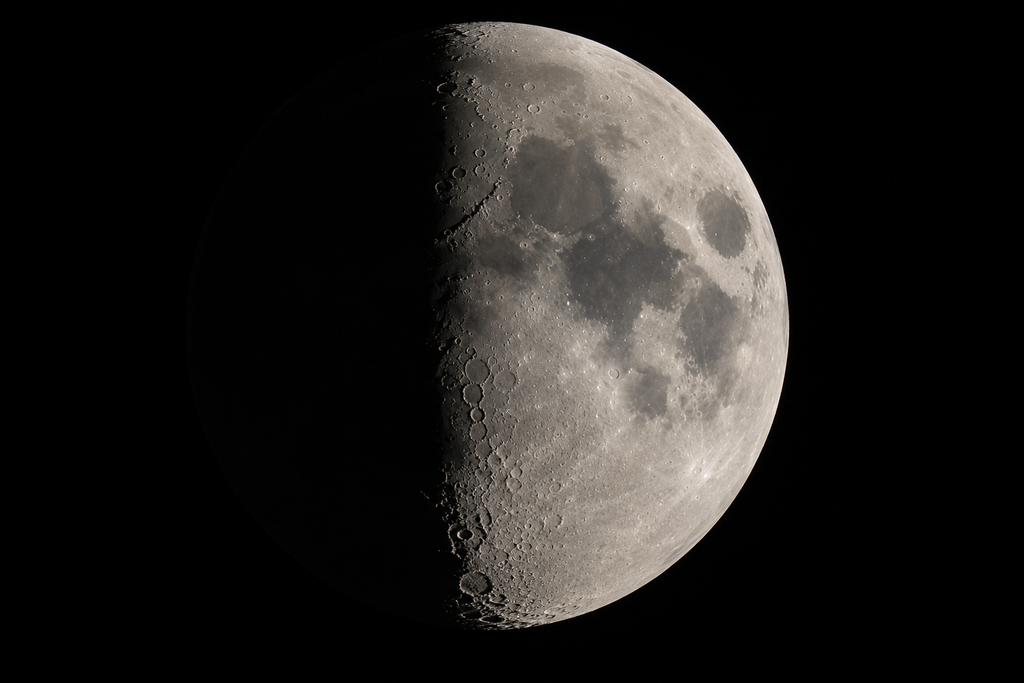
The reason is the terminator, the boundary between lunar daylight and darkness. Near First Quarter, low-angle sunlight creates strong shadows along craters, mountains and ridges, making the lunar surface appear much more three-dimensional than it often does near Full Moon.
From Chennai, roughly 6:30 pm to 10:30 pm is a convenient family viewing window.
Light pollution hardly matters for such a bright target, making this an excellent night for children and first-time telescope users. If someone in your family has never looked closely at another world before, the Moon around First Quarter is one of the easiest places to begin.
October 21–22: How to Watch the Orionid Meteor Shower from Chennai
The Orionids, produced by debris left behind by Halley’s Comet, peak around October 21–22. A bright waxing gibbous Moon interferes with the 2026 display, but Chennai still gets a useful predawn opportunity. NASA specifically recommends trying after the Moon has set.
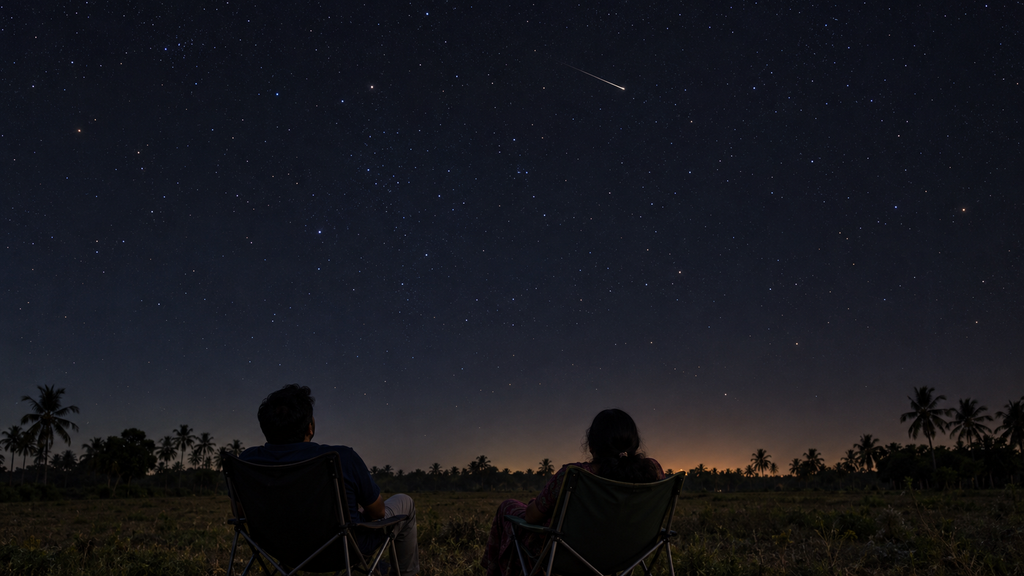
On October 22, the Moon sets at about 2:22 am in Chennai. The better viewing window is therefore roughly 2:30 am to 5:15 am, before dawn becomes too bright.
You do not need to look directly at Orion. The radiant tells astronomers where the meteors appear to originate, but individual Orionids can streak across a broad area of sky.
Find a dark location, avoid bright phone screens and allow your eyes 20–30 minutes to adapt. For the Orionids, travelling outside Chennai is worth considering.
October 24: Use the Moon to Find Saturn
The bright Moon appears near Saturn on October 24, creating an easy beginner navigation exercise.
Find the Moon first, then look nearby for Saturn as a bright, steady point.
The pairing is useful during the evening, and moonlight is not a serious problem for identifying Saturn. Once you find the planet with your eyes, move to a telescope to look for its rings.
That simple progression — Moon → bright point → Saturn’s rings through the telescope eyepiece — is an excellent way to introduce children and beginners to practical sky navigation.
October 26: Full Moon Rising Over Chennai
The exact Full Moon occurs on October 26 at about 9:41 am IST, during daylight in Chennai. The practical viewing moment comes that evening when the Moon rises at about 5:45 pm toward the east-northeast. Chennai-specific lunar data places moonrise at approximately 5:46 pm.
Full Moon is not the best phase for studying crater shadows because sunlight falls more directly across the lunar face. But it remains one of the easiest and most impressive naked-eye sights in the sky.
An open eastern horizon makes moonrise especially enjoyable.
If you are unsure what is realistically visible from an urban terrace, our guide to stargazing in Chennai explains why the Moon and bright planets remain excellent city targets even when faint deep-sky objects disappear into the glow.
October 27–28: Moon Meets the Pleiades
On the night of October 27 into 28, the Moon passes close to the Pleiades, also called the Seven Sisters. NASA identifies this as another of October’s easy skywatching highlights.
Look east during the evening as both climb higher.
The Pleiades can be seen without optical aid under good skies, but the nearly Full Moon will wash out some of the fainter stars. From Chennai, binoculars are the better choice because they reveal more of the cluster despite the glare.
Which October Night Is Best for You?
| Your Goal | Best Date |
|---|---|
| See Saturn through a telescope | October 4 |
| Easy beginner planet spotting | October 4, 6 or 24 |
| Best binocular event | October 11 |
| Best Moon detail | October 18 |
| Dark-sky trip | October 9–12 |
| Meteor watching | October 8 evening or October 22 before dawn |
| Full Moon / moonrise experience | October 26 |
| Family telescope evening | October 4, 18 or 24 |
Can You See All of This from Chennai City?
Not equally.
The Moon, Saturn, Jupiter and Mars are strong city-sky targets because they are bright. The Beehive Cluster and Pleiades benefit from binoculars and darker surroundings. Meteor showers benefit most from leaving the city.
Choose the right target for the sky you have: a Chennai terrace works well for planets and the Moon; darker skies are better for meteors and faint objects.
That distinction is important. A powerful telescope cannot simply “remove” Chennai’s light pollution, but you also do not need perfectly dark skies to have a rewarding astronomy experience.
Make October 2026 a Month You Actually Look Up
October gives Chennai several very different experiences: Saturn’s rings, Mars among the Beehive stars, the cratered First Quarter Moon, predawn Orionids and a bright Full Moon rising over the city.
If you would rather have the telescope set up and the sky explained as you observe, Stargazing Chennai offers guided experiences for beginners, families, children, couples and small groups. Sessions are planned around the date, location, weather and what is realistically visible.
For couples looking to make one of these evenings a little more personal, you can also explore our private stargazing experiences for couples in Chennai.
The sky does not need to be perfectly dark to create a memorable first look. Sometimes Saturn’s rings in the eyepiece are enough.
Turn Your Evening Under the Stars Into a Memory for Two
Enjoy a private stargazing experience with your partner, complete with guided telescope views, quiet sky moments and a night planned around you.
FAQs About the October 2026 Night Sky in Chennai
What is the best sky event in Chennai in October 2026?
For most observers, Saturn at opposition around October 4 is the strongest all-round event. It is easy to locate, visible for much of the night and dramatically better through a telescope.
When is the New Moon in Chennai in October 2026?
New Moon occurs on October 10 at about 9:20 pm IST. October 9–12 is therefore the best period for darker-sky observing.
Can I see Saturn’s rings from Chennai?
Yes, with a telescope and suitable conditions. Saturn itself is visible to the naked eye, but its rings require magnification.
When is the Orionid meteor shower best from Chennai?
A useful window is around 2:30 am to 5:15 am on October 22, after the bright Moon has set.
Do I need a telescope for October’s sky events?
No. The Moon, Saturn, Mars, Jupiter and meteors can all be found without one. A telescope adds detail to the Moon and planets, while binoculars are especially useful for the Beehive Cluster and Pleiades.
What is the best October date for children or beginners?
October 18 is excellent for the First Quarter Moon, while October 4 and October 24 are especially good for combining easy Saturn identification with telescope viewing.
Leave a Reply