

Table of Contents
When was the last time you looked up at night and saw the glowing band of the Milky Way stretching overhead?
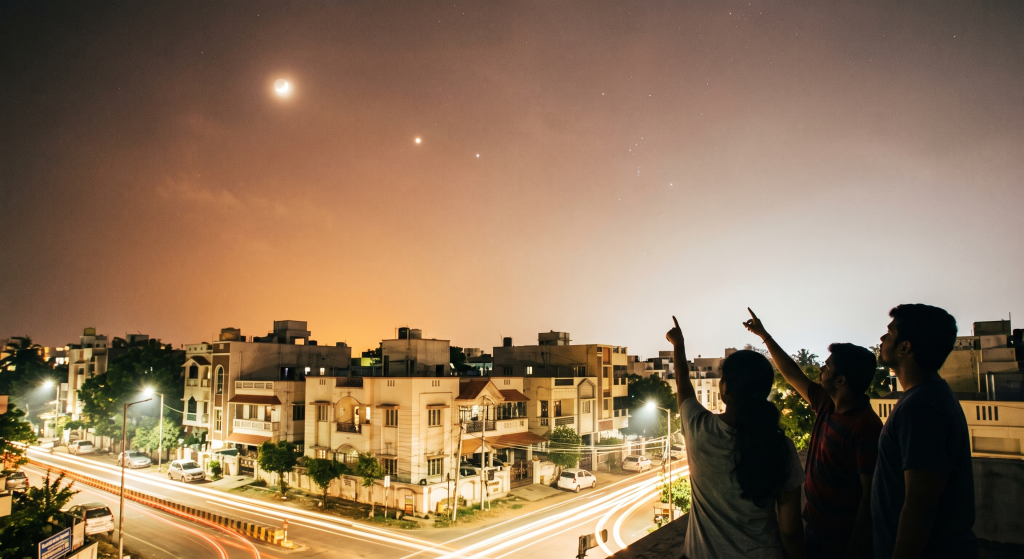
If you live in central Chennai, whether amidst the streetlights of Velachery, the commercial bustle of T. Nagar, or the high-rises along OMR, your view of the cosmos is restricted to a pale, orange-tinted haze. On any given night, you might spot the Moon, Venus, Jupiter, and barely twenty of the brightest stars.
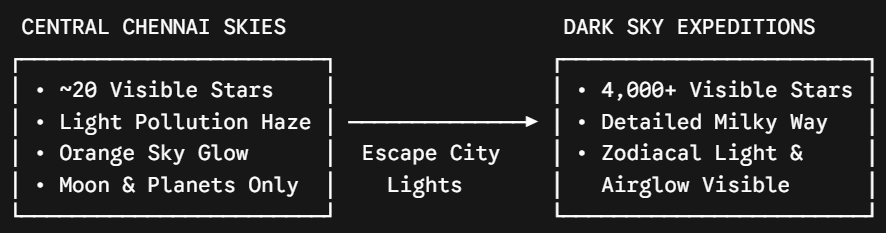
To find truly dark skies, amateur astronomers, astrophotographers, and weekend adventurers rely on a single standardized metric: The Bortle Dark-Sky Scale.
This guide breaks down how the Bortle scale works, uncovers the hidden truths about light pollution maps, details gear strategies by sky class, and maps out dark-sky destinations across India—from weekend escapes near Chennai to high-altitude reserves in the Himalayas.
What is the Bortle Scale?
Created in 2001 by American amateur astronomer John E. Bortle and published in Sky & Telescope magazine, the Bortle Scale is a nine-level numerical classification system used to quantify night-sky darkness.
- Class 1 represents the purest, darkest skies remaining on Earth.
- Class 9 represents the light-polluted skies of an inner-city core.
The Bortle Scale Spectrum
| Class 1 | Class 3-4 | Class 5-6 | Class 8-9 |
| Pristine | Rural | Suburban | Inner City |
| Dark Sky | Dark Park | Skyglow | Light Haze |
| Hanle | Kolli & Yelagiri Hills | City Outskirts | City Lights |
Before John Bortle published this scale, observers described sky quality using vague adjectives like “pretty good” or “fairly dark”. The Bortle scale introduced a shared observational language built on what your eyes can actually detect in the sky—such as the structure of the Milky Way, the visibility of faint deep-sky objects, and light domes on the horizon.
Measuring Sky Darkness: Bortle vs. SQM vs. NELM
To accurately evaluate an observing site, astronomers combine three primary metrics:
| Metric | Type | What It Measures |
| Bortle Class | Observational | Human visual criteria (1 to 9) |
| SQM Rating | Instrumental | Surface brightness (mag/arcsec^2) |
| NELM Rating | Human Visual | Faintest visible star at zenith |
Bortle Class (1–9): An overall qualitative assessment based on visible celestial features, airglow, and light domes.
Sky Quality Meter (SQM): An electronic device that measures sky surface brightness in magnitudes per square arcsecond (mag/arcsec^2). A theoretical pure dark sky measures approx 22.00 (mag/arcsec^2), while a light-polluted city center measures below 18.00 (mag/arcsec^2).
Naked-Eye Limiting Magnitude (NELM): The apparent magnitude of the faintest star you can see near the zenith without optical aid.
The Master Sky Brightness Scale
| Bortle Class | Description | SQM Range (mag/arcsec2) | NELM Range | What the Sky Looks Like |
| Class 1 | Pristine Dark Sky | 21.76 – 22.00 | 7.6 – 8.0 | Milky Way casts ground shadows; Zodiacal light and airglow striking. |
| Class 2 | Truly Dark Site | 21.60 – 21.75 | 7.1 – 7.5 | Milky Way resembles veined marble; clouds appear as dark voids. |
| Class 3 | Rural Sky | 21.30 – 21.59 | 6.6 – 7.0 | Faint light domes on horizon; complex detail visible in Milky Way core. |
| Class 4 | Rural – Sub Urban Transition | 20.40 – 21.29 | 6.1 – 6.5 | Light domes visible over population centers; Milky Way clearly detailed overhead. |
| Class 5 | Suburban Sky | 19.10 – 20.39 | 5.6 – 6.0 | Milky Way looks washed out near horizons; clouds noticeably brighter than sky background. |
| Class 6 | Bright Suburban Sky | 18.50 – 19.09 | 5.1 – 5.5 | Grayish-white horizon glow; Milky Way visible only directly overhead at zenith. |
| Class 7 | Suburban – Urban Transition | 18.00 – 18.49 | 4.6 – 5.0 | Strong sky glow in all directions; Milky Way completely invisible. |
| Class 8 | City Sky | 17.00 – 17.99 | 4.1 – 4.5 | Orange or whitish-gray sky; familiar constellations incomplete. |
| Class 9 | Inner-city Sky | <17.00 | <4.0 | Entire sky brightly lit; only Moon, major planets, and brightest stars visible. |
Two Critical Dark-Sky Gaps Most Guides Miss
When researching stargazing sites online, rely on more than basic light pollution applications. Most guides overlook two key factors:
1. “The Map Lie” (Outdated Satellite Maps)
Many popular light pollution applications rely on satellite datasets compiled nearly a decade ago (such as the 2015 World Atlas model).
Due to rapid urban development, industrial lighting expansion, and the widespread shift toward unshielded white LED streetlights, real-world light pollution has increased by 7% to 10% annually.
Warning for Stargazers: A remote location listed as a Bortle 3 on an old map may actually measure as a Bortle 4 or 5 on the ground today. Always verify sky darkness using ground reports or live SQM readings.
2. Directional Light Domes (360-Degree Sky Dynamics)
A Bortle rating evaluates sky quality directly overhead at the zenith. However, key celestial targets—such as the Milky Way core or seasonal constellations—often sit lower toward the horizon.
- If you set up at a Bortle 4 campsite located North of a major city, looking South toward the city light dome drops your effective viewing quality down to Bortle 6 or 7.
- Always position yourself upwind of urban light sources relative to your intended observing target.
Best Dark Sky Spots Across India (Categorised by Bortle Class)
1. Hanle Dark Sky Reserve (Ladakh)
- Bortle Class: Class 1
- SQM Rating: 21.80 – 22.00 mag/arcsec^2
- Why It’s Special: Perched at 4,500 meters altitude on the Changthang Plateau, Hanle is home to India’s first certified Dark Sky Reserve and the Himalayan Chandra Telescope. Thin air and minimal moisture yield extremely clear views. Airglow and the zodiacal light are routinely visible to the naked eye.
2. Spiti Valley (Langza, Kibber & Dhankar, Himachal Pradesh)
- Bortle Class: Class 1–2
- SQM Rating: 21.70 – 21.90 mag/arcsec^2
- Why It’s Special: High altitude and mountain barriers block ambient light, revealing the structured dust lanes of the summer Milky Way with sharp clarity.
3. Greater Rann of Kutch (Gujarat)
- Bortle Class: Class 2
- SQM Rating: 21.60 – 21.75 mag/arcsec^2
- Why It’s Special: The flat salt desert offers uninterrupted $360^\circ$ horizon views, making it a favorite for wide-angle landscape astrophotography.
Class 3 to 4: Rural Skies & Dark Sky Parks
1. Kolli Hills Dark Sky Park (Namakkal District, Tamil Nadu)
- Bortle Class: Class 3–4
- SQM Rating: 21.10 – 21.40 mag/arcsec^2
- Drive Time from Chennai: ~6 hours via NH44
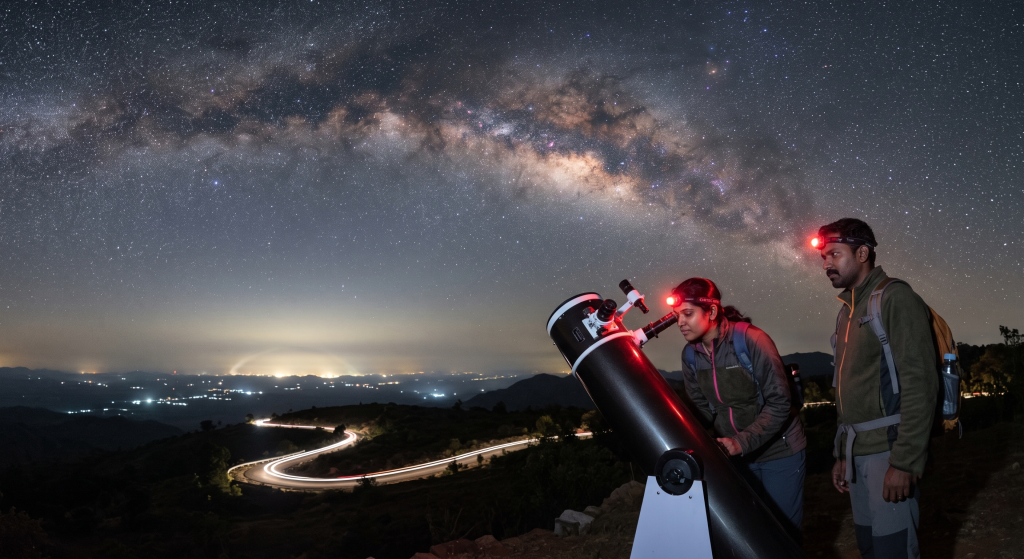
- Why It’s Special: Located inside the Ariyur Shola Reserve Forest, Tamil Nadu’s dark sky initiative features protected forest buffers that preserve low light pollution levels. It offers South Indian stargazers an accessible location to view the Milky Way core.
2. Astroport Sariska (Alwar, Rajasthan)
- Bortle Class: Class 4
- SQM Rating: 20.80 – 21.10 mag/arcsec^2
- Drive Time from Delhi NCR: ~3.5 hours
- Why It’s Special: Situated adjacent to the Sariska Tiger Reserve, this site uses dark-sky-friendly shielded fixtures and solar power to keep local light pollution low.
3. Javadi Hills & Kavalur (Tirupathur District, Tamil Nadu)
- Bortle Class: Class 4
- SQM Rating: 20.60 – 21.00 mag/arcsec^2
- Drive Time from Chennai: ~4 hours via NH48
- Why It’s Special: Home to the Vainu Bappu Observatory. Elevated terrain and surrounding forest buffers provide a reliable weekend escape for stargazers traveling from Chennai or Bengaluru.
Dark Sky Weekend Escapes Near Chennai
For observers based in Chennai, traveling to Ladakh isn’t always practical for a weekend trip.
Below is an itinerary of accessible locations organized by distance and sky quality:
| Destination | Travel Time | Bortle Rating | Key Targets |
| Pulicat / ECR | 1.5 – 2 Hrs | Class 5–6 | Planets, Moon, Orion |
| Javadi Hills | 3.5 – 4 Hrs | Class 4 | Milky Way, Star Clusters |
| Kolli Hills Park | 6 Hrs | Class 3–4 | Deep Sky, Faint Galaxies |
| Kodaikanal Pockets | 8 – 9 Hrs | Class 2–3 | Astrophotography Core |
1. Pulicat Lake & Northern Coast (1.5 to 2 Hours)
- Bortle Class: Class 5–6
- Ideal for night-drive astrophotography practice, wide-angle planetary alignment shots, and observing bright deep-sky targets like the Orion Nebula or Pleiades.
2. Javadi Hills & Kavalur (3.5 to 4 Hours)
- Bortle Class: Class 4
- Offers clear views of the Milky Way during spring and summer months without severe skyglow overhead.
3. Kolli Hills Dark Sky Park (5.5 to 6 Hours)
- Bortle Class: Class 3–4
- Tamil Nadu’s dedicated stargazing location. Features clean horizons, low humidity, and moderate elevation for visual astronomy.

Bring the Night Sky to Your Family’s Own Space
Create a meaningful evening at home with the Moon, planets, and the joy of discovering the sky together.
Astrophotography Strategies by Bortle Class
Adjust your target selection and equipment choice based on local light pollution conditions:
| Sky Quality | Best Optical Filters | Preferred Imaging Targets |
| Bortle 8–9 (City Center) | Dual-Band / H alpha Narrowband Filters | Moon, Planets, Emission Nebulae |
| Bortle 4–5 (Suburban) | Broadband Light Pollution Filters (CLS) | Bright Galaxies, Star Clusters, Milky Way Core |
| Bortle 1–3 (Dark Site) | No Filters Required (Pure RGB Broadband) | Dark Nebulae, Reflection Nebulae, Dusty Core Lanes |
Urban Skies (Bortle 8–9: Central Chennai)
- Primary Targets: Lunar surfaces, Jupiter’s Galilean moons, Saturn’s ring system, double stars (e.g., Albireo), and bright planetary nebulae.
- Filter Strategy: Utilize narrowband filters (e.g., H alpha, OIII, SII or dual-band pass filters to block urban LED wavelengths while capturing faint emission targets.
Suburban Transition (Bortle 4–5: Javadi / Yelagiri Outskirts)
- Primary Targets: The Milky Way core, the Andromeda Galaxy (M31), the Orion Nebula (M42), and globular clusters (M13, M22).
- Filter Strategy: Light pollution suppression filters help preserve contrast when imaging toward distant city light domes.
Dark Sky Reserves (Bortle 1–3: Hanle / Kolli Hills)
- Primary Targets: Faint integrated flux nebulae (IFN), dark dust lanes in Serpens/Sagittarius, reflection nebulae, and wide-field panoramas.
- Filter Strategy: No filters required. Use standard RGB broadband capture to record natural color fidelity.
Ready to Experience True Dark Skies with Stargazing Chennai?
Join our guided dark sky expeditions, private telescope camps, and hands-on astrophotography workshops tailored for families, students, and night-sky enthusiasts.
Frequently Asked Questions on Bortle Scales
Q1: What is the Bortle scale rating of Chennai?
Central Chennai (e.g., Anna Nagar, T. Nagar, Velachery, OMR) falls under Bortle 8 to 9 due to high urban light density. Coastal suburban areas towards Kovalam or Mahabalipuram average around Bortle 6 to 7.
Q2: Where is the darkest sky spot in India?
Hanle in Ladakh is officially recognized as a Bortle Class 1 site. Situated at 4,500 meters altitude within the Changthang Wildlife Sanctuary, it hosts India’s first Dark Sky Reserve.
Q3: How do I find my local Bortle class rating?
You can estimate your sky quality using digital planning apps like Stellarium, PhotoPills, or Clear Outside. Cross-reference these digital predictions with a visual check on clear, moonless nights to account for local light growth.
Q4: Can I view the Milky Way in a Bortle 4 sky?
Yes. In a Bortle 4 sky (such as Kolli Hills or Javadi Hills), the Milky Way core appears clearly visible to the naked eye overhead, though subtle detail near the horizon can be affected by distant town light domes.
Leave a Reply